- Mawlynnong Village Meghalaya — Is Asia's Cleanest Village Worth the 3-Hour Drive?
- Quick Facts — Mawlynnong at a Glance
- How Mawlynnong Got the "Cleanest Village" Title
- How to Reach Mawlynnong from Shillong
- Mawlynnong Things to Do — The Complete List
- The Honest Assessment — Is Mawlynnong Over-Hyped?
- Combining Mawlynnong with Dawki — The Perfect Day Trip
- Mawlynnong Entry Fee and Other Costs
- Mawlynnong Best Time to Visit
- Where to Eat in Mawlynnong
- Should You Stay Overnight at Mawlynnong?
- Photography Tips for Mawlynnong
- The Real Takeaway — What Mawlynnong Teaches Us
- Mawlynnong Compared to Nearby Attractions
- Budget Summary for the Day Trip
- Frequently Asked Questions
Mawlynnong Village Meghalaya — Is Asia's Cleanest Village Worth the 3-Hour Drive?
Let's get this out of the way: Mawlynnong village Meghalaya is genuinely clean. Spotless, actually. Bamboo dustbins line the pathways. Not a single plastic wrapper on the ground. Every leaf, every twig — swept up and composted. The village of about 500 people, most of them Khasi, has been maintaining this standard long before any tourism board showed up with a camera.
But here's the part nobody puts in the headline: Mawlynnong is small. Really small. You can walk through the entire village in 30 to 45 minutes. There are maybe five things to see. If you're driving 3 hours from Shillong expecting a full-day destination, you'll feel shortchanged.
So is it worth going? Yes — but only if you plan it right. Combine it with Dawki and the Umngot River, which is just 17 km away, and suddenly you've got a full day that's one of the highlights of any Meghalaya itinerary. Go to Mawlynnong alone and you'll wonder what the fuss was about. Go as part of a Dawki-Mawlynnong loop and it clicks.
This guide covers what to actually do there, how to get there, what it costs, and — honestly — how long you really need.

Quick Facts — Mawlynnong at a Glance
| Detail | Info |
|---|---|
| Location | East Khasi Hills, Meghalaya |
| Altitude | ~1,200 metres (3,937 ft) |
| Population | ~500 people |
| Famous For | Asia's cleanest village (title from Discover India, 2003) |
| Distance from Shillong | 92 km (3 hours by road) |
| Distance from Dawki | 17 km (30-40 minutes) |
| Entry Fee | 50 INR per person |
| Time Needed | 30-45 minutes for the village, 1.5-2 hours including root bridge |
| Best Months | October to March |
| Mobile Network | BSNL patchy; Jio and Airtel mostly dead |
| ATM | None — carry cash from Shillong |
How Mawlynnong Got the "Cleanest Village" Title
In 2003, Discover India magazine ran a story calling Mawlynnong the cleanest village in Asia. In 2005, the same publication reportedly expanded the claim to the cleanest village in the world. No standardized global survey was involved. No one went village to village across Asia with a clipboard.
That matters because the title gets repeated everywhere — in government brochures, travel blogs, Instagram captions — as if it's a verified fact. It isn't, technically. But that doesn't mean the claim is hollow either.
Mawlynnong's cleanliness isn't a marketing stunt. It's a deeply rooted community practice. The Khasi people here have been maintaining their surroundings for generations, long before tourists started showing up. Every household is responsible for cleaning the area in front of their home. The village operates a community cleaning schedule — like a rotation system — where different families take turns sweeping shared pathways and common areas.
Bamboo dustbins sit at every turn. Waste gets sorted and composted. Plastic is collected and stored (though what happens to it after that is less clear — rural waste management in India is a bigger problem than any single village can solve). The point is, the cleanliness isn't performative. It's cultural.
The real story here isn't "look at this clean village." It's that an entire community decided, collectively and voluntarily, to maintain their environment — and they've done it for decades. That's genuinely impressive regardless of whether some magazine made an unverifiable "Asia's cleanest" claim.
How to Reach Mawlynnong from Shillong
The drive from Shillong to Mawlynnong is 92 km and takes about 3 hours. It's not a hard drive, but it's not a highway either. Expect two-lane roads, some curves, and the occasional slow truck to overtake.
Route Options
Option 1: Shillong to Mawlynnong direct (via Pynursla) The standard route. 92 km, about 3 hours. Road condition is decent — paved the whole way, but narrow in stretches. You'll pass through small towns and some beautiful Khasi countryside.
Option 2: Shillong to Dawki first, then Dawki to Mawlynnong This is the smarter route if you're doing both in one day. Shillong to Dawki is 82 km (about 3 hours). Then Dawki to Mawlynnong is just 17 km (30-40 minutes). Hit Dawki in the morning when the Umngot River light is best for photos, then drive up to Mawlynnong after.
Option 3: Cherrapunji to Mawlynnong If you're already based in Cherrapunji, you can reach Mawlynnong via Dawki. It's about 100 km total and takes 3.5 hours. Longer, but makes sense if Dawki is on the same day.
Transport Costs
| Mode | Cost | Notes |
|---|---|---|
| Shared Sumo (Shillong to Mawlynnong) | 250-350 INR per person | Leaves from Bara Bazaar, morning only |
| Private taxi (Shillong - Dawki - Mawlynnong - Shillong) | 3,500-4,500 INR (sedan) / 4,500-5,500 INR (SUV) | Full day loop, best value |
| Private taxi (Shillong to Mawlynnong only) | 2,500-3,200 INR | One-way; return costs the same |
| Self-drive rental | 1,200-3,000 INR/day + 1,200 INR fuel | Split 3-4 ways, cheapest option |
The full-day Shillong-Dawki-Mawlynnong-Shillong loop by private cab is the best value. You hit two of Meghalaya's biggest attractions in one day for 3,500-5,500 INR total. Split between 3-4 people, that's under 1,500 INR each for transport. Shared Sumos to Mawlynnong are infrequent and don't always run — a private cab is more reliable for this route. Check our Meghalaya trip cost guide for a full breakdown.
Driving Tips for the Shillong-Mawlynnong Route
Start early. Leave Shillong by 6:30-7:00 AM if you're doing the Dawki-Mawlynnong combo. This gets you to Dawki by 9:30-10:00 AM when the river light is perfect, gives you time for boating, then Mawlynnong by early afternoon. You'll be back in Shillong by 6-7 PM.
The road from Dawki up to Mawlynnong climbs through thick forest. It's narrow but paved. Drive carefully — the occasional pothole catches people off guard.
Mawlynnong Things to Do — The Complete List
Here's everything you can actually do in Mawlynnong. I'm being comprehensive, which also means being honest about how much time each thing takes.
1. The Bamboo Sky Walk (Machan)
This is Mawlynnong's most photographed spot. It's a bamboo platform — locals call it a machan — built on top of a tall bamboo structure at the edge of the village. You climb up a bamboo staircase (about 80-85 feet) to a viewing platform that overlooks the village, the surrounding forest, and on clear days, the plains of Bangladesh in the distance.
The view is genuinely good. On a clear morning you can see for miles — green hills rolling into the flatlands across the border. On a cloudy day, you'll still get a decent view of the treetops and the village below.
The climb up is a bit wobbly. The bamboo structure sways slightly. If you have a real fear of heights, this might not be your thing. It's perfectly safe — the structure is rebuilt regularly and maintained by the village — but your knees might disagree with your brain on that.
Time needed: 15-20 minutes including the climb.
2. The Living Root Bridge
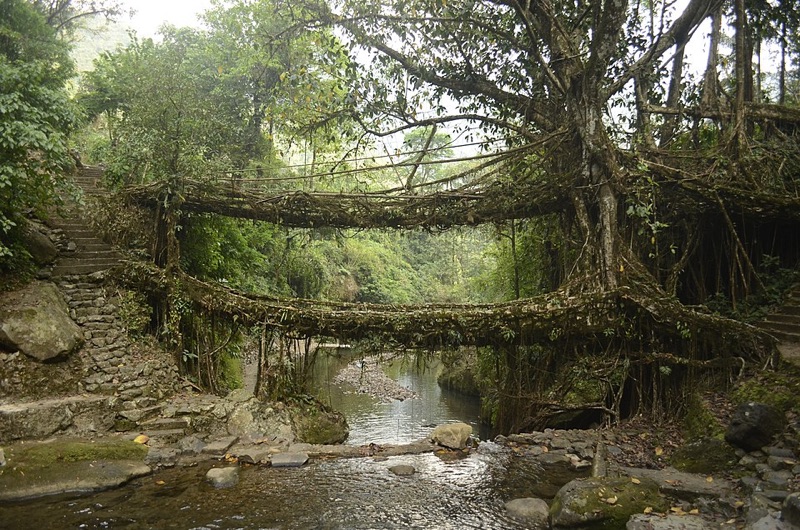
Mawlynnong has its own living root bridge, and it's a good one — though much smaller than the famous double decker living root bridge at Nongriat. This is a single-level root bridge, about 20-25 metres long, spanning a small stream on the edge of the village.
Getting there takes a short walk — about 15-20 minutes from the main village area. The path descends through forest, and there are stone and concrete steps most of the way. It's not a trek. Anyone with reasonable mobility can do it.
The Mawlynnong living root bridge doesn't get the crowds that the Nongriat one does, which is actually a plus. You can stand on it, take photos without 30 people in frame, and appreciate the root architecture without feeling rushed. The roots are thick, alive, and the bridge is actively maintained by the community.
Time needed: 30-40 minutes including the walk there and back.
Visit the root bridge before or after the main village. Most tour groups stick to the village area and the sky walk, then leave. The root bridge path is quieter, especially in the afternoon when day-trippers are heading out.
3. The Balancing Rock
About 5 km from Mawlynnong (towards Riwai village), there's a large boulder balanced on a much smaller rock. It looks like it should topple over, but it's been sitting there — balanced — for as long as anyone can remember.
Is it going to blow your mind? No. It's a rock on a rock. But it's on the way between Dawki and Mawlynnong, so you'll pass it regardless. Stop for two minutes, take a photo, appreciate the randomness of geology, and move on.
Time needed: 5 minutes.
4. The Church and Village Walk
Mawlynnong is predominantly Christian (like much of Meghalaya's Khasi population), and the small church at the centre of the village is a quiet, well-kept structure. It's not architecturally remarkable, but it's a focal point of community life.
The village walk itself is the main experience. Wander the pathways. Look at the bamboo dustbins. Notice how every garden is tended. The houses are modest but well-maintained — flower pots, painted fences, swept yards. The pathways are lined with flowering plants and bougainvillea.
Talk to the locals if they're around. Many speak English (Meghalaya has high English literacy) and are proud to explain how the cleaning system works. Some families offer tea if you're polite about it.
Time needed: 15-20 minutes for a full loop.

5. Riwai Village and Root Bridge
Riwai is a smaller village about 1.5 km from Mawlynnong. It has its own living root bridge — sometimes listed separately as the "Riwai root bridge." It's similar to Mawlynnong's but in a slightly different setting. If you've already seen the Mawlynnong root bridge, Riwai's is a pleasant extension but not essential.
The walk between the two villages is nice — forest path, quiet, shaded.
Time needed: 20-30 minutes if you're already at Mawlynnong.
The Honest Assessment — Is Mawlynnong Over-Hyped?
Alright, let's talk about this directly because it's the question most people have after they visit.
The hype says: "Asia's cleanest village! Must-visit! Life-changing experience!"
The reality: It's a clean, well-maintained Khasi village. It's pleasant. It's photogenic. The community's commitment to cleanliness is admirable and worth seeing. The sky walk has a nice view. The root bridge is cool.
But it takes 30-45 minutes to see everything in the main village. If you've driven 3 hours from Shillong specifically for Mawlynnong, it can feel thin. I've talked to travelers who loved it and travelers who said, "That was it?"
Here's what determines whether you'll feel it was worth it:
- You'll love it if you combine it with Dawki, take your time, appreciate the community model, and aren't expecting a theme park.
- You'll feel let down if you drive 3 hours each way just for Mawlynnong alone and expect it to fill a whole day.
- The sweet spot: arrive mid-morning after Dawki boating, spend 1.5-2 hours at Mawlynnong (village + root bridge + sky walk), have lunch, and head back.
The real value of Mawlynnong isn't the Instagram shots. It's seeing that an entire community can maintain their environment to this standard through collective effort. In a country where littering is a national pastime, Mawlynnong is proof that it doesn't have to be that way. Take that thought home with you — it's worth more than the photos.
Don't litter here. This sounds obvious, but it needs saying. Carry out everything you bring in. Don't leave water bottles behind. Don't toss wrappers assuming someone else will pick them up. The village's cleanliness depends on everyone — including visitors — respecting the standard. And if you're a smoker, there's no smoking in the village.
Combining Mawlynnong with Dawki — The Perfect Day Trip
Dawki is only 17 km from Mawlynnong. Not doing both in the same day is a mistake. Here's the ideal schedule for the Dawki and Mawlynnong day trip.
Recommended Schedule
| Time | Activity | Notes |
|---|---|---|
| 6:30 AM | Leave Shillong | Beat the tourist crowds |
| 9:30-10:00 AM | Arrive at Dawki | Morning light on the river is best |
| 10:00-11:30 AM | Umngot River boating | 30-45 min ride, 800-1,200 INR per boat |
| 11:30 AM-12:00 PM | Walk the Dawki suspension bridge | Free, 10 min |
| 12:00-12:30 PM | Drive to Mawlynnong | 17 km, 30-40 min |
| 12:30-1:00 PM | Lunch at Mawlynnong | Limited options, basic but fine |
| 1:00-2:30 PM | Explore Mawlynnong | Village walk, sky walk, root bridge |
| 2:30-3:00 PM | Stop at Balancing Rock | On the way, 5 min |
| 3:00-6:00 PM | Drive back to Shillong | 92 km, 3 hours |
| 6:00-6:30 PM | Arrive Shillong | In time for dinner at Police Bazaar |
That's a full day. You'll cover two of Meghalaya's biggest-name attractions without feeling rushed. The early start matters — the Umngot River at Dawki looks best before noon when the sun is directly overhead and the water transparency is at its peak.
If you're doing the full Meghalaya circuit, this day fits perfectly between your Cherrapunji days and your return to Shillong. See our complete Meghalaya itinerary for how to sequence everything.
Mawlynnong Entry Fee and Other Costs
Mawlynnong charges a small entry fee that goes toward village maintenance. Here's the full cost breakdown.
Entry and Activity Fees
| Item | Cost (2026) |
|---|---|
| Village entry fee | 50 INR per person |
| Sky walk / machan | Included in entry fee |
| Living root bridge | Included in entry fee |
| Balancing Rock (near Riwai) | 20 INR per person |
| Parking | 20-30 INR per vehicle |
| Camera fee | None (phone and camera both free) |
Complete Day Trip Budget (Dawki + Mawlynnong from Shillong)
| Expense | Budget | Mid-Range |
|---|---|---|
| Transport (Shillong-Dawki-Mawlynnong-Shillong) | 700-900 INR (shared) | 900-1,400 INR (private cab, split 4 ways) |
| Dawki boating | 300-400 INR (split boat) | 400-600 INR (private boat split 2 ways) |
| Mawlynnong entry | 50 INR | 50 INR |
| Balancing Rock entry | 20 INR | 20 INR |
| Parking | 20 INR | 20 INR |
| Lunch | 100-200 INR | 200-400 INR |
| Snacks and water | 50-100 INR | 100-200 INR |
| Total per person | ~1,250-1,700 INR | ~1,700-2,700 INR |
Under 2,700 INR per person for a full day covering two of Meghalaya's top attractions. That's outstanding value. For a complete spending plan, our Meghalaya trip cost breakdown covers all expenses across 5 and 7-day trips.
Mawlynnong Best Time to Visit
Mawlynnong is pleasant most of the year, but the experience changes significantly with the seasons.
| Season | Months | Weather | Crowds | Verdict |
|---|---|---|---|---|
| Post-Monsoon | Oct-Nov | Cool, clear skies, lush green | High (peak tourist season) | Best overall — everything looks its finest |
| Winter | Dec-Feb | Cool to cold (8-18 degrees C), dry | Moderate | Great weather, comfortable for walking |
| Pre-Monsoon | Mar-May | Warm (20-30 degrees C), some haze | Low-Moderate | Fine, but sky walk views can be hazy |
| Monsoon | Jun-Sep | Heavy rain, humid, paths can be muddy | Very Low | Greenest, but rain makes outdoor time difficult |
October and November are the best months. The village is at its greenest after the monsoon, the air is clear for sky walk views, and the root bridge stream has good water flow. It's also peak tourist season, so expect company.
December to February is my recommendation for a quieter visit. The weather is comfortable — cool but not cold. Fewer tour groups. The village looks just as clean. The sky walk views are sharp on clear winter mornings.
Monsoon (June-September) makes the village incredibly green but the rain can be relentless. Paths get slippery. The root bridge walk involves descending steps that become tricky in wet conditions. The sky walk might be closed during heavy rainfall. Not ideal.
For seasonal planning across all of Meghalaya, check best time to visit Northeast India.
Where to Eat in Mawlynnong
Let's be honest: food options in Mawlynnong are limited. There are a handful of small eateries and homestay-run kitchens, but don't expect a menu with choices.
What's available:
- 2-3 small restaurants in the village serving rice, dal, vegetables, and sometimes chicken or pork
- One or two stalls near the entrance selling tea, Maggi noodles, and packaged snacks
- Homestay kitchens that can prepare basic meals if you ask in advance
What it costs:
- Thali-style rice meal: 100-200 INR
- Maggi noodles: 40-60 INR
- Tea: 15-20 INR
- Bottled water: 20-30 INR
What to do about it: Eat a proper breakfast in Shillong before leaving. If you're doing the Dawki-Mawlynnong loop, you can eat at one of the restaurants near Dawki's boating point — slightly more variety there. Carry snacks and water from Shillong.
The food in Mawlynnong isn't bad — it's just basic. Rice and dal prepared simply. If you're okay with that, you're fine. If you need options, plan around it.
There's no ATM in Mawlynnong. There's no reliable UPI or card payment either. Carry enough cash from Shillong for the day — entry fees, food, parking, everything. Budget 500-600 INR in cash minimum for the Mawlynnong portion of your day.
Should You Stay Overnight at Mawlynnong?
Short answer: probably not, unless you specifically want the quiet morning experience.
Why overnight stays appeal to some people:
- You get the village to yourself at sunrise and sunset, when all the day-trippers have left
- Morning walks through a silent, spotless village are genuinely peaceful
- You can hear the forest, the birds, the stream — no traffic, no tourists
- The homestay experience gives you a window into Khasi village life
Why most people don't need to stay:
- You can see everything in 1.5-2 hours
- The village has no nightlife, no restaurants open past 7-8 PM, and limited electricity
- Accommodation is basic — homestays with shared bathrooms, bucket water, and intermittent phone signal
- You're better off sleeping in Shillong where you have restaurant options, WiFi, and a comfortable room
Accommodation if you do stay: There are 4-5 homestays in Mawlynnong. Rooms are basic but clean — this is the cleanest village, after all. Expect to pay 600-1,000 INR per person including dinner and breakfast. Rooms have beds, blankets, and mosquito nets. Some have attached bathrooms, some are shared. No air conditioning (you won't need it — the altitude keeps it cool).
My suggestion: if you're a photographer who wants early morning light on the village, or if you want to slow travel and genuinely connect with the place, stay one night. For everyone else, the day trip from Shillong covers it.
Photography Tips for Mawlynnong
Mawlynnong is photogenic but tiny. Here's how to get good shots without spending hours there.
Best light: Morning (8-10 AM) or late afternoon (3-5 PM). Midday sun is harsh and the village paths are mostly shaded, creating contrast problems.
Sky walk: Bring a wide-angle lens or use your phone's ultra-wide mode. The view from the top is expansive — the wider the better. Shoot facing south for the Bangladesh plains, or east/west for the forest canopy.
Root bridge: The bridge is shaded by forest canopy. You'll need to bump up ISO or use a slower shutter speed. A tripod isn't practical on the bridge itself (it sways slightly with movement), but a small handheld one works for the approach shots.
Village pathways: The bamboo dustbins, flower-lined paths, and painted fences make good subjects. Shoot early when the paths are empty. Once tour groups arrive (usually 11 AM onwards), the narrow pathways fill up.
People: Ask before photographing locals. Most are friendly about it, but ask first. The kids are often happy to pose.
The cliche shot: Person standing on the clean pathway with bamboo dustbins on either side. Everyone takes it. Go ahead and take it too — then look for something more interesting. The church entrance, the root bridge in the mist, a close-up of the bamboo bin weaving.
The Real Takeaway — What Mawlynnong Teaches Us
I said earlier that the real value of Mawlynnong isn't the photographs. I meant it.
India produces over 60 million tonnes of municipal solid waste per year. Walk through any Indian town and you'll see garbage in drains, plastic bags in trees, rivers choked with waste. We've accepted that as normal.
Then there's Mawlynnong. A village of 500 people who decided that filth isn't normal. They didn't wait for a government scheme. They didn't need an NGO to tell them how to keep their surroundings clean. They just did it — collectively, voluntarily, for generations.
The composting, the bamboo dustbins, the rotation cleaning schedule — none of this is expensive or high-tech. Any village could do it. Any colony in any Indian city could do it. The difference is that Mawlynnong actually did.
That's the thought worth taking home. Not "wow, such a clean village for Instagram." But "if 500 people in a remote Meghalaya village can do this, why can't we?"
Mawlynnong Compared to Nearby Attractions
Planning your day? Here's how Mawlynnong stacks up against other attractions in the area, so you can prioritize.
| Attraction | Distance from Mawlynnong | Time Needed | Wow Factor | Should You Go? |
|---|---|---|---|---|
| Dawki (Umngot River) | 17 km (30-40 min) | 1-2 hours | High — crystal clear river, boating | Absolutely yes. Do both same day |
| Balancing Rock (Riwai) | 5 km (10 min) | 10 minutes | Low-Medium — interesting but quick | Yes, it's on the way |
| Krang Suri Falls | 55 km (1.5 hours) | 2-3 hours | High — stunning waterfall with swimming | Yes if you have extra time |
| Cherrapunji (Sohra) | 100 km (3.5 hours) | Full day | High — waterfalls, caves, viewpoints | Do separately, not same day |
| Nongriat (Double Decker Root Bridge) | 90 km (3 hours) + trek | Full day or overnight | Very High — the trek of a lifetime | Do separately |
| Shillong | 92 km (3 hours) | Half to full day | Medium — pleasant hill town, cafes | Your base, not a day trip |
The Dawki-Mawlynnong-Balancing Rock combination is the natural grouping. Everything else is too far to reasonably combine in one day.
Budget Summary for the Day Trip
Here's the bottom line on what your Dawki-Mawlynnong day costs at different spending levels.
| Category | Solo Budget | Couple Mid-Range | Group of 4 Mid-Range |
|---|---|---|---|
| Private cab (full day) | 4,000 INR | 4,500 INR (2,250 each) | 5,000 INR (1,250 each) |
| Dawki boating | 800 INR (solo boat) | 1,000 INR (500 each) | 1,200 INR (300 each) |
| Entry fees (Mawlynnong + Balancing Rock) | 70 INR | 140 INR (70 each) | 280 INR (70 each) |
| Parking | 30 INR | 30 INR | 30 INR |
| Lunch | 150 INR | 400 INR (200 each) | 800 INR (200 each) |
| Snacks and water | 100 INR | 200 INR (100 each) | 400 INR (100 each) |
| Total per person | ~5,150 INR | ~1,560 INR | ~970 INR |
Solo travel in Meghalaya is expensive because of private cab rates. Travel with even one other person and costs drop dramatically. A group of 3-4 gets the per-person cost under 1,000 INR for a full day at two major attractions. If you're solo and budget-conscious, use shared Sumos — the Shillong to Dawki shared taxi costs 300-400 INR, and from Dawki to Mawlynnong you can sometimes find shared rides for 150-200 INR.
Frequently Asked Questions
Is Mawlynnong really the cleanest village in Asia?
The title comes from Discover India magazine, which named Mawlynnong the cleanest village in Asia in 2003. It wasn't based on a comprehensive survey of every village in Asia — it was an editorial observation. That said, the village is genuinely, remarkably clean. The community has maintained a systematic cleaning model for generations, with shared responsibility, bamboo dustbins, composting, and plastic collection. The title might be editorially granted rather than scientifically verified, but the cleanliness itself is undeniably real.
How much time do you need at Mawlynnong?
Plan for 1.5 to 2 hours to see everything comfortably. That includes the village walk (15-20 minutes), the sky walk/machan (15-20 minutes), and the living root bridge (30-40 minutes). If you skip the root bridge, 30-45 minutes covers the village. Most organized tour groups spend about 45 minutes.
Is Mawlynnong worth visiting, or is it over-hyped?
It depends on your expectations. If you're expecting a massive, bustling attraction, you'll be disappointed — it's a small, quiet village. If you appreciate community-driven cleanliness, enjoy a short forest walk to a root bridge, and combine it with Dawki in the same day, it's a worthwhile stop. Don't make it your only destination for the day. Pair it with Dawki and it becomes part of one of Meghalaya's best day trips.
Is there a living root bridge at Mawlynnong?
Yes. Mawlynnong has a single-level living root bridge about a 15-20 minute walk from the main village. It's smaller than the famous double decker root bridge at Nongriat but still impressive and much easier to reach — no 3,500-step trek required. The path involves descending some steps through forest, but it's manageable for anyone with basic mobility.
Can I visit Mawlynnong and Dawki in one day from Shillong?
Absolutely. This is the recommended way to do it. Leave Shillong by 6:30-7:00 AM, reach Dawki by 9:30-10:00 AM for boating, then drive 17 km to Mawlynnong for lunch and village exploration. You'll be back in Shillong by 6:00-6:30 PM. It's a long day in the car (6-7 hours total driving), but the roads are scenic and the two attractions complement each other perfectly.
What should I carry to Mawlynnong?
Cash (500-600 INR minimum, no ATM available), water bottle, sunscreen, a light rain jacket (weather changes fast in Meghalaya), comfortable walking shoes for the root bridge path, and your camera. Don't bring large bags — there's nowhere to store them and you won't need them. For a comprehensive gear list for Meghalaya travel, check our Meghalaya itinerary guide.
If you're planning the full Meghalaya trip, the most efficient sequence is: Day 1-2 Shillong, Day 3-4 Cherrapunji (including the root bridge trek), Day 5 Dawki and Mawlynnong, Day 6 return to Shillong/Guwahati. This avoids backtracking and covers all the major attractions. Our complete Meghalaya itinerary has the full day-by-day route.
Compare Northeast India Tour Packages
Find the best-value packages from top operators. Compare prices, itineraries, and reviews in one place.
Compare Packages NowGet Our Free Northeast India Planning Checklist
Subscribe to our newsletter and receive a downloadable checklist covering packing, permits, booking timeline, and more.
Subscribe Free